

31 July 2026
The Local Loop
What a community of growers, makers and producers builds when they share the same space.
There is a version of the story about local food that is mostly about freshness. About the carrots being pulled that morning, the bread still warm. That version is true, and it matters. But it is also the least interesting part of what happens when a community builds a functioning local food system.
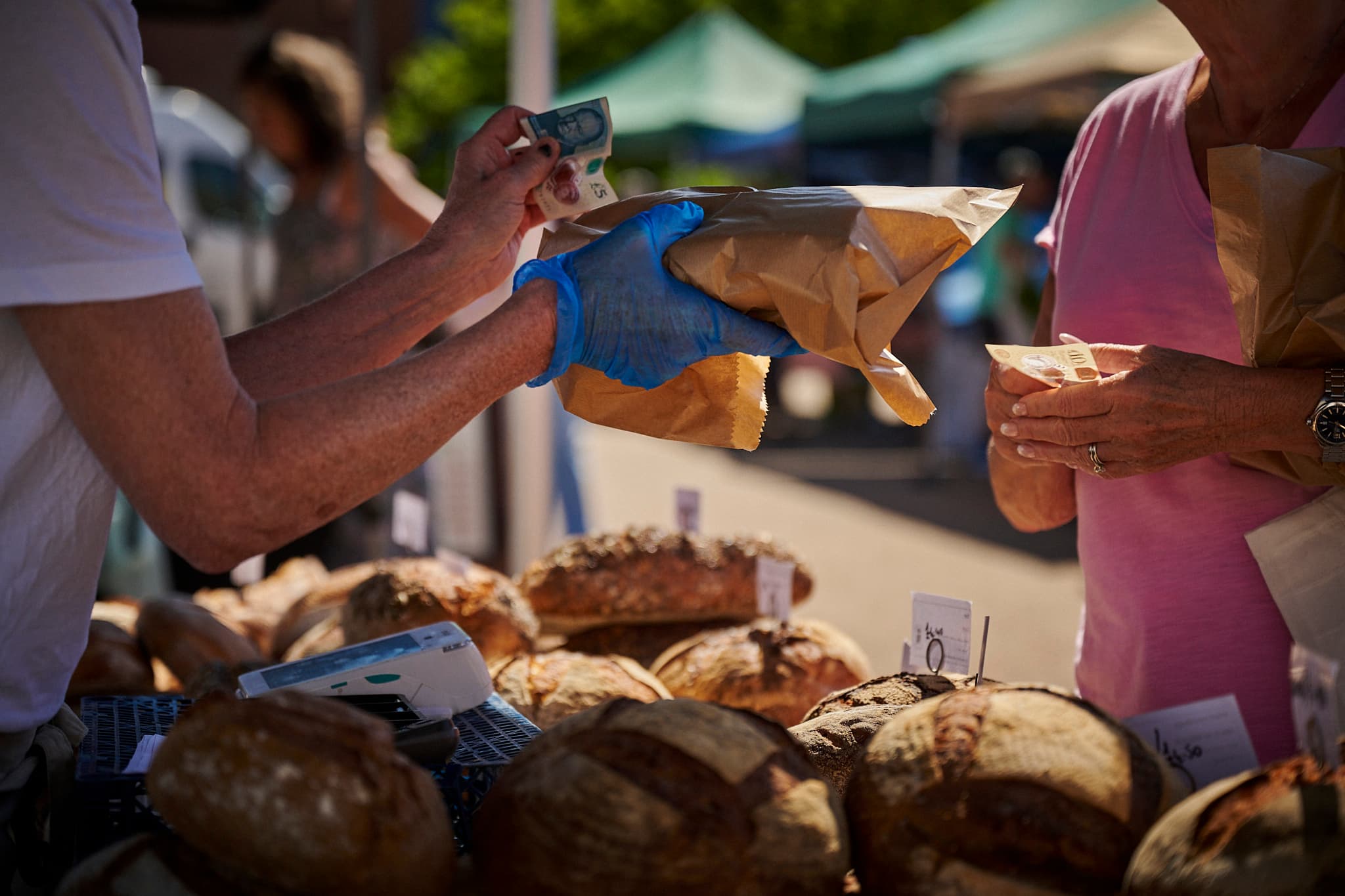
At Lewes Farmers Market, Ashurst Organics' surplus vegetables, the misshapen, undersized, overgrown ones that supermarkets would reject, go to Preserved by Jay, who turns them into jams, chutneys and pickles sold at the next stall along. Guns'n'Posies and Sharon's Home Baking, and others across the market, collect their egg orders from Philpots Farm at the market each fortnight. The stalls become a quiet wholesale exchange between producers who have found each other through proximity and trust. Across the market, this kind of relationship repeats: local suppliers feeding local makers, producers becoming each other's customers, a micro-economy of mutual dependency that nobody has ever particularly advertised. It is not presented as a feature of the market. It is simply what a community of growers, makers and producers builds when they share the same space.
It is also often the only moment when a grower actually meets the person eating their food. A question asked across a trestle table, how did you grow this, what goes well with it, is something a supermarket aisle cannot replicate. These conversations are small, but they matter: they are the beginning of a relationship between producer and consumer that makes both more accountable to each other.
But the loop doesn't end at the market gates.
Harvey's Brewery sends spent grain to Plumpton College to feed livestock. The Trevor Arms in Glynde brews its own beer, serves it on site, and sources almost everything else from Sussex farms and producers, a pub running on the same logic as the market, applied to a whole business. These are not gestures. They are economic choices: decisions to keep value circulating locally rather than disappearing into a supply chain that begins and ends somewhere else.
This is not a feel-good story about community spirit. It is a description of how an economy is supposed to work.
The concept of Community Wealth Building, developed by the Democracy Collaborative in the United States and brought to the UK through Preston City Council and the Centre for Local Economic Strategies, argues that local economies are most resilient when wealth, resources and decision-making power circulate within them rather than leaking out to distant shareholders. A farmers market is, in miniature, a proof of concept. The money spent on a loaf from Flint Owl doesn't go to a distribution centre in the Midlands. It stays. It gets spent at the butcher, the childminder, the local independent restaurant. The Lewes Pound understood this instinctively. Economists call it the local multiplier effect. In February 2026, Scotland became the first place in the world to enshrine Community Wealth Building in law. England has not yet followed.
The circular economy makes the same argument from a different angle. Where conventional food systems are linear, grow, transport, sell, discard, a local food system can close the loop. Surplus becomes ingredient. Waste becomes resource. The relationship between producer and consumer becomes legible again.
What is less visible is how rarely the producers and businesses doing this work actually know each other, or trade together outside the market. Seasons Wholefoods in Lewes acts as a hub for local produce year-round, connecting growers with everyday shoppers beyond the fortnightly market. Across Sussex, others in hospitality and retail are making the same choices quietly, without infrastructure or visibility to support them. These connections exist. But they are isolated. There is no system holding them together.
That is what Foodwave is trying to build. Not a food fair, but a network: a directory of producers, growers, makers and retailers across Sussex; a programme connecting local farms directly to local businesses that have never bought from them; a food security initiative that starts with fresh surplus from local producers and asks what more can be done with it, preserved, dried, cured, frozen into meals, transformed rather than just distributed, rather than focusing on long-life products with a supermarket origin. The ambition is a model that builds food literacy alongside access: teaching people to preserve and cook from what's in season. The aim is to build something alongside the remarkable work already happening in food banks, a local food system that is proactive rather than reactive, and that treats good food as infrastructure rather than charity.
There is a longer argument here too. Local food is often called expensive, and for many people, it currently is. But that cost premium is largely a function of fragility: small producers without guaranteed buyers, low volumes, no shared infrastructure. A stable local distribution network changes the economics. When local farms have reliable income and local businesses have reliable suppliers, unit costs come down. The gap between a Sussex tomato and a supermarket one narrows.
The stallholders at Lewes Farmers Market have been building this for thirty years. Foodwave wants to take it further, into the restaurants, the shops, the institutions, and the conversations that decide what gets grown, what gets cooked, and who gets to eat well.
Nava, Director, Common Cause
← All Field Notes